Continuous-flow evaluation and molecular insight of vermiculite-immobilized peroxidase in pharmaceutical removal
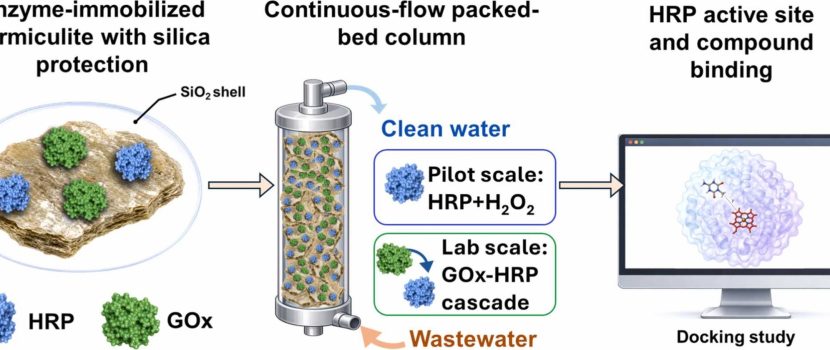
Enzymatic wastewater treatment offers a sustainable alternative to conventional technologies. In this study, vermiculite-supported horseradish peroxidase and glucose oxidase-horseradish peroxidase biocatalysts were developed and evaluated under continuous-flow treatment of real municipal wastewater and treated municipal wastewater at industrial pilot scale and laboratory scale. Enzymes were immobilized on acid-treated vermiculite flakes and stabilized via silica encapsulation, achieving retained activities of 420 U g−1 for horseradish peroxidase and 390 U g−1 for glucose oxidase, with enzyme leaching below 2%. The industrial pilot-scale horseradish peroxidase system, operated with external hydrogen peroxide dosing on effluent wastewater containing eight pharmaceutical contaminants at concentrations of 30–300 ng L−1, achieved complete or near-complete removal of six target compounds, while caffeine and ketoprofen remained recalcitrant. The laboratory-scale glucose oxidase-horseradish peroxidase -vermiculite cascade operated on treated wastewater containing sixteen pharmaceuticals at concentrations of 140–7500 ng L−1, achieving sustained removal above 96% for nine compounds including metoprolol, bisoprolol, venlafaxine, citalopram and clarithromycin over 9 h of continuous operation, while carbamazepine, hydrochlorothiazide and lamotrigine remained largely unaffected. Molecular docking simulations of horseradish peroxidase with the target compounds provided molecular-level insight into differences in predicted substrate recognition, binding location, and interactions within the catalytic region. Compounds poorly transformed by horseradish peroxidase generally showed less favorable or less catalytically accessible binding patterns, while efficiently transformed compounds adopted poses involving residues surrounding the distal heme pocket. Overall, the results demonstrate the potential of vermiculite-based immobilized enzyme systems for scalable wastewater treatment, as well as molecular docking as a practical tool to investigate enzyme-micropollutant interactions.
Reference: VARDANYAN, Ani; EWERTH, Adam; SPEKSNIJDER, Bent; EDERER, Jakub; KŘÍŽENECKÁ, Sylvie et al. Continuous-flow evaluation and molecular insight of vermiculite-immobilized peroxidase in pharmaceutical removal. Online. Environmental Technology & Innovation. 2026, vol. 44, s. 105291. ISSN 2352-1864. Available at: https://doi.org/10.1016/j.eti.2026.105291.
The archive of other published articles can be found here