Where Should Spray Cans Go? Přestanov Tests Collection as Scientists Seek Precious Metals
Deodorant, hairspray, paint, or camping stove gas cartridges. Aerosol sprays are a common part of households, but after use, it is often unclear where to dispose of them. Pressurized cans end up in regular trash, creating containers full of flammable gases.
The Faculty of Environment at UJEP, together with the village of Přestanov, has therefore launched a pilot collection of aerosol packaging. Researchers want to find out what containers people actually throw away, how much content remains inside them, and whether a safe recycling method can be designed.
“Recycling aluminum uses approximately 95% less energy than producing new metal. Recycling a single aluminum aerosol container saves roughly as much energy as running a 10W LED light bulb continuously for 40 hours,” adds the project’s lead researcher, Ing. Tomáš Lank.
A Problem Nobody Has Solved Yet
In the Czech Republic, there is essentially no unified system for fully and safely recycling aerosol cans that still contain even a minimal amount of propellant gas.
“Today, people dispose of sprays in various ways—typically either in metal recycling bins or simply in the black residual waste bins, while non-empty ones should ideally be taken to a recycling center. Recommendations on where to throw them are not uniform across the Czech Republic, and expert opinions differ. There is also no single interpretation for correctly determining whether a spray can is truly empty. Once flammable contents remain inside a container—even a seemingly empty one—it becomes potentially explosive waste,” explains the main technical hurdle Assoc. Prof. Ing. Jiří Orava, Ph.D., from the Faculty of Environment at UJEP.
The containers are made of aluminum, the production of which significantly burdens the environment. The scientists’ goal is to design an entirely new recycling line and technology specifically tailored to these cans. However, to achieve this, they first need to know exactly what people are throwing into the bins.
Why Přestanov? A Village with a Crystal Trophy
Přestanov, located near Ústí nad Labem, has experienced a significant influx of new residents in recent years—according to 2025 data, 633 citizens live here. It is an ideal location for this unique research for two reasons: it lacks heavy industry, and the local residents are exceptionally close to environmental protection.
“We chose the village of Přestanov because of our long-term cooperation, and it will allow us to gain insight into what people actually use and discard in their households,” explains Associate Professor Orava.
Local residents are also champions at sorting waste. In 2024, Přestanov won 2nd place in the Křišťálová popelnice (Crystal Dustbin) competition for outstanding results in sorting plastics, paper, and PET bottles. Partnering with the university was a logical step for the municipal leadership.
“We consider it extremely important for people to sort waste correctly,” says Mayor Mgr. Miroslava Bechyňová, adding: “We want to cooperate with UJEP because it is a great source of information for us. Furthermore, we believe the university is full of smart minds who always come up with something great, and we want to be right at the source of this progress.”
How Does the Collection Work?
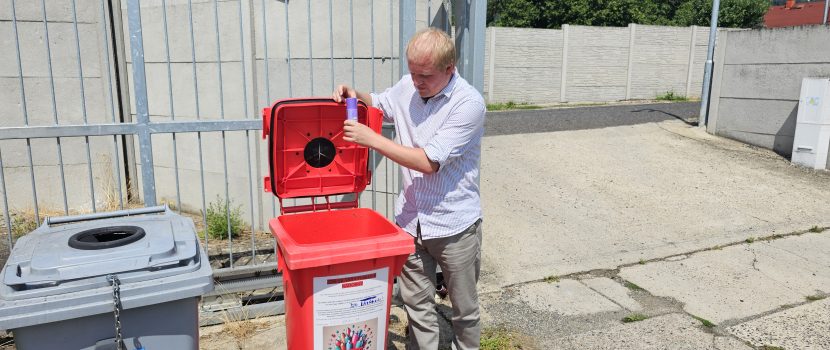
The collection process follows specific rules. A dedicated red bin has been newly placed at the local recycling point in the village. Access is restricted exclusively to residents of Přestanov, who open the yard gate using a registered electronic chip. This ensures that waste from other areas—which could skew statistical results—does not appear in the container.
Researchers actively welcome residents throwing in sprays that are not completely empty or are expired. They need to analyze the actual material and chemical composition of the contents to obtain representative data and properly design the future recycling line.