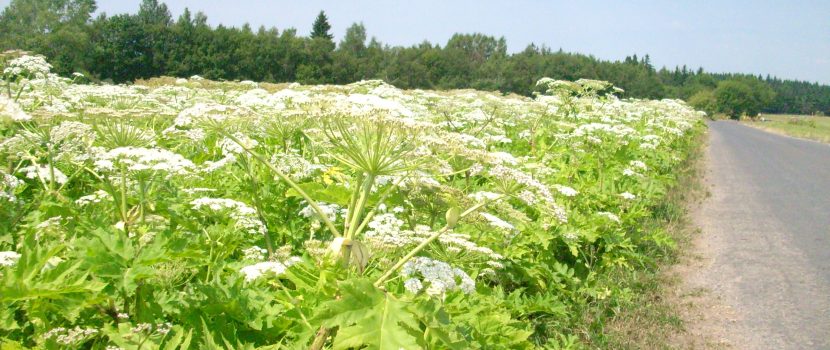
New Study Shows How to Tackle Invasive Species
Biological invasions are among the greatest threats to nature, the economy, and human health. Three years ago, following four years of preparation, the Intergovernmental Science-Policy Platform on Biodiversity and Ecosystem Services (IPBES) published the Assessment Report on Invasive Alien Species and their Control. Experts from 49 countries contributed to the report, including Mgr. Jana Müllerová, PhD, representing the Faculty of Environment at Jan Evangelista Purkyně University in Ústí nad Labem (UJEP). The report now serves as a key decision-making foundation for addressing biological invasions in more than 70% of the world’s countries represented by IPBES.
The report states that the global economic costs associated with invasive alien species exceeded $423 billion in 2019, and invasive species contributed to 60% of recorded global extinctions. In the Czech Republic, we face a number of invasive species that displace native flora and fauna, alter ecosystem functions, cause health issues including allergies, and complicate landscape management or flood protection. Well-known examples include knotweeds, giant hogweed, Himalayan balsam, and black locust.
The ongoing Invasive Species Week serves as a reminder that successful nature conservation relies not just on the eradication of problematic organisms, but primarily on prevention, proper timing, high-quality information, and qualified decision-making.
Following up on the犯aforementioned IPBES Assessment Report, the same international scientific team introduced a new decision-making framework for managing biological invasions in the journal Biological Invasions. The study highlights the need to define key factors of effective invasion management that decision-makers should consider simultaneously: objectives, tasks, and effective measures, which must always correspond to the specific phase of the invasion, the type of environment, and a realistic management goal.
The End of One-Size-Fits-All Solutions. Timing Is Everything.
When an invasive species spreads massively across a landscape, it is usually too late for simple solutions. Management costs soar, interventions become more complex, and the recovery of the damaged ecosystem to its original state remains uncertain. Therefore, scientists are presenting a clear IPBES framework that expands on earlier, simplified invasion curves and helps determine which type of measure makes sense at a given stage of the invasion.
“Invasive species are not a problem that can be solved with a single, universal recipe. It depends on whether we are talking about prevention, early detection, eradication efforts, containment, or the restoration of a damaged ecosystem,” explains Jana Müllerová. “The new framework connects specific invasion phases with clear goals and meaningful measures. First, we must precisely determine which phase we are in and what the realistic objective of the intervention is, so we don’t waste resources unnecessarily.”
The IPBES framework distinguishes four main approaches to invasion management:
- Prevention Phase (Zero Occurrence): The most effective and economically cheapest. The goal is to monitor introduction pathways (e.g., soil imports, construction activity, seed sales).
- Rapid Response Phase (First Outbreaks up to 10% of the area): The only window of opportunity to completely eradicate the species in a given locality. Interventions (e.g., mechanical removal of giant hogweed before flowering or rigorous removal of blooming individuals) must take place as soon as possible after reporting.
- Control/Regulation Phase (Moderate Infestation, 10–50% of the area): Complete eradication is often no longer realistic (depending on the invasive species and the ecosystem). In this case, the goal is to keep the invasion under control—meaning preventing further spread into the landscape (e.g., mowing knotweed at the edges of the outbreak, creating protective buffer zones, and managing pathways of spread, such as road networks or waterways within a catchment area).
- Asset Protection / Acceptance Phase (Massive Infestation over 50% of the area): Area-wide interventions are no longer implemented here. Efforts are focused on protecting the most valuable assets—such as removing black locust in the immediate vicinity of a protected steppe locality.
“In biological invasions, time is often the deciding factor. The sooner we detect a species, the higher the chance we can stop it. Prevention is the cheapest option; once an invasive species spreads, management shifts from a relatively inexpensive, rapid, and targeted intervention to long-term, costly work with limited efficacy, focusing instead on mitigating the negative impacts of the invasion,” Müllerová adds.
Water and Land: Two Different Worlds Requiring Different Strategies
A fundamental contribution of the study is the clear categorization of management based on the type of environment. The framework explicitly distinguishes terrestrial and closed aquatic ecosystems from marine and other interconnected aquatic systems. In interconnected aquatic environments, the situation is much more complex because organisms can spread via water currents, shipping, or migratory animals, such as whales, making the boundaries of the infested area much harder—if not entirely impossible—to define.
“On land or in closed aquatic systems, we have a wider range of options. We can attempt complete eradication, containment of further spread, long-term control, and ecosystem restoration after the invasion is cleared,” describes Müllerová. “In interconnected rivers, seas, and other open aquatic systems, the situation is significantly more complicated. Once an invasive species spreads, its complete removal is often highly challenging. This makes prevention, pathway control, and early detection all the more critical.”
From Mere Eradication to Healing the Landscape
Traditional approaches have often focused mainly on the mechanical or chemical removal of invasive plants and animals. However, the new international framework emphasizes that eradication alone does not always solve the problem. If a disturbed site or ecosystem is left behind after an intervention, the invasive species may return, or other problematic species might replace it.
“It is not enough to eradicate an invasive species once and just walk away,” warns Müllerová. “Successful management requires long-term effort, supporting the regeneration of native species, and monitoring outcomes. Ecosystem restoration is often just as important as the intervention against the invasive species itself.”
For instance, simply eradicating invasive plants creates a “dead zone” of bare soil. This is an ideal launching pad for new seeds of invasive species from the surroundings. A successful formula depends on the characteristics of the invasive species and the affected ecosystem. For example, in the case of our most problematic species, it requires:
- Grass seeding: After eradicating giant hogweed or knotweed near a river, it is necessary to sow the area with an appropriate regional mix of deep-rooting grasses to prevent erosion and leave no room for seedlings of other problematic species.
- Active shading: Both knotweed and giant hogweed thrive in the sun. Planting competitively strong native woody plants (such as alders and willows along watercourses) creates shade that naturally suppresses the growth of light-loving invasive plants.
- Regular mowing: No chemical or mechanical intervention destroys 100% of the root system. Without subsequent regular grazing or mowing, the site will return to its originally infested state within two years.
- Regular monitoring: It is crucial to monitor the area over the long term following interventions. For example, giant hogweed seeds can remain viable in the soil for up to 6 years, and live rhizome fragments of knotweed can remain in the ground, from which a new plant can grow.
Modern Technologies: Drones, Satellites, and AI Help Ensure Timely Intervention
Early detection and effective monitoring of landscape changes are significantly facilitated by modern technologies today. The Faculty of Environment at UJEP has a long-standing focus on utilizing Earth observation (satellite, aerial, and drone data), spatial analysis, and other geoinformatics tools to track changes in the landscape.
Among other things, these methods make it possible to map the occurrence of invasive plants, track their spread over time, study their invasive behavior, and evaluate whether the measures taken are genuinely working. Combined with field surveys, knowledge of the biology of specific species, and data sharing, they can significantly improve decision-making for land managers and conservationists.
In the new study, scientists remind us that successful invasion management is not just an academic matter. It requires close and coordinated cooperation among state administration, local governments, landowners, nature conservationists, land managers, researchers, and the general public. Without data sharing, clear rules, and long-term support, even well-intentioned interventions will remain isolated attempts with short-term effects.
Further Information:
- Egawa, C. et al. (2026). The IPBES invasion-management framework supports informed decision-making for managing biological invasions. Biological Invasions, 28, 133.
- IPBES (2023). Thematic Assessment Report on Invasive Alien Species and their Control of the Intergovernmental Science-Policy Platform on Biodiversity and Ecosystem Services. Roy, H. E., Pauchard, A., Stoett, P., and Renard Truong, T. (eds.). IPBES secretariat, Bonn, Germany. DOI: https://doi.org/10.5281/zenodo.7430682
- Müllerová, J., Brundu, G., Große-Stoltenberg, A., Kattenborn T. & Richardson, D.M. (2023). Pattern to process, research to practice: Remote sensing of plant invasions. Biological Invasions, 25, 3651–3676. https://doi.org/10.1007/s10530-023-03150-z
- Plesník, J. (2023). IPBES discussed invasive alien species. Ochrana přírody 6/2023. https://www.casopis.ochranaprirody.cz/mezinarodni-ochrana-prirody/ipbes-jednal-o-invaznich-nepuvodnich-druzich/
- Roy, H.E. et al. (2024). Curbing the major and growing threats from invasive alien species is urgent and achievable. Nat Ecol Evol, 8, 1216-1223.
IPBES is an independent intergovernmental body established in 2012 (currently comprising 143 member countries, including the Czech Republic since 2014, with the Nature Conservation Agency of the Czech Republic acting as the national coordinator). Its objective is to strengthen the science-policy interface for biodiversity and ecosystem services. IPBES synthesizes the latest expert knowledge on the subject, including causes, trends, and effective tools to address these challenges. A vital role of IPBES is also to facilitate dialogue among academia, government, and the general public, as well as to inform and educate them. In its assessments, IPBES considers the needs of all landscape users, with quality of life being one of its core values. Learn more about IPBES at https://www.ipbes.net/about.
One of the main tasks of IPBES is the preparation of Assessment Reports on various topics related to biodiversity conservation; find out more here: https://www.ipbes.net/assessing-knowledge