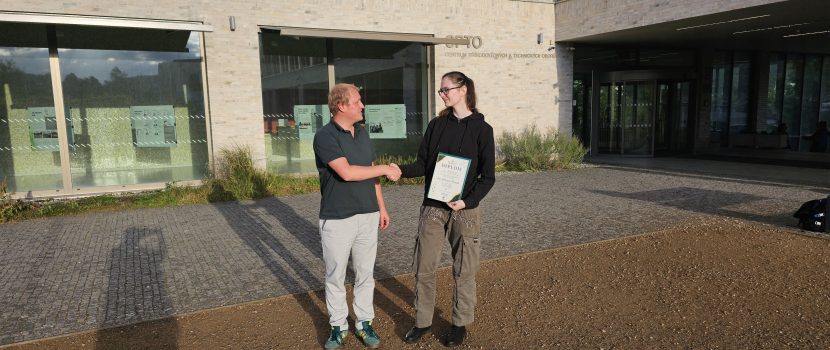
UJEP Student Wins Award for Research on Eco-Friendly Battery Recycling
Gabriela Novotná from the Faculty of the Environment at UJEP investigated how to recover valuable raw materials from spent electric vehicle batteries using more environmentally friendly acids. In doing so, she tested whether the process could handle material from two different types of batteries. For her master’s thesis, she received the Karel Velek Award, which recognizes the best master’s theses in the field of waste management.
Chemical battery recycling typically involves strong solutions of sulfuric acid, for example. Handling them requires strict safety measures, and the resulting wastewater must be purified. Research at the Ústí-based faculty sought a greener alternative. Student Gabriela Novotná tested a method using weaker citric acid in combination with other green chemicals.
“We wanted to use a weaker acid, specifically citric acid. It decomposes easily in nature and does not pollute the environment. I tested whether it would also work for leaching metals into solution,” explains Gabriela Novotná. The recovered raw materials can then be reused to manufacture lithium-ion batteries. Engineer Jiří Štojdl served as her consultant during the research.
Thesis topics at the faculty often stem from real-world problems addressed in collaboration with companies. “In chemistry, we have no problem with students finding topics at all. On the contrary, we could accommodate even more students,” says her thesis supervisor, Associate Professor Jiří Orava.
Black Mass Research
Gabriela Novotná focused on what is known as black mass—a powdered material derived from spent lithium batteries. It is precisely from this powder that manufacturers attempt to extract valuable metals and other elements for reuse. She examined NMC-type batteries, whose cathode material contains nickel, manganese, and cobalt, as well as LFP batteries containing lithium, iron, and phosphate.
During experiments, approximately 90 percent of the targeted elements were successfully leached into solution. This represents the efficiency of a single recycling step, which must be followed by the separation of the individual raw materials. “We achieved yields very similar to those obtained by conventional hydrometallurgical methods using strong mineral acids,” says Novotná.
Faculty Collaboration with Industry
The results demonstrated that the procedure can also work with a mixture of both battery materials. In the future, this could simplify the joint processing of batteries with different compositions and improve operational economics. Gabriela Novotná built upon technology developed through a collaboration between the faculty and the company IBG Česko s.r.o. In her thesis, she tested and adjusted it for the materials under study.
Assoc. Prof. Jiří Orava views collaboration with external partners as an opportunity for students to solve real problems. “Project-based education and solving real-world challenges will become increasingly important,” he says. The faculty is also involved in battery research through the international INERRANT project, which focuses on developing safer and recyclable batteries.