NATIONAL PARK AND FACULTY OF THE ENVIRONMENT LAUNCH PODCAST
The Bohemian Switzerland National Park Administration and the Faculty of the Environment at Jan Evangelista Purkyně University (UJEP) are launching a joint podcast titled GREEN TEA (ZELENÝ ČAJ). The project aims to provide a space for environmental debate without oversimplified shortcuts. The podcast is intended to serve as a platform for discussing various perspectives on the environment, including those that may clash.
The first episode will be released on Thursday, April 9, 2026, with subsequent episodes following every two weeks. The format consists of one-on-one interviews lasting approximately 45 minutes. The inaugural guest is Professor Jakub Hruška, a scientist and prominent commentator on environmental issues who has long been a fixture in public debates regarding landscape and climate.
A Space for Competing Perspectives
Guests will hail from diverse fields and backgrounds. “Discussions focused on environmental topics go far beyond the domain of nature conservation. We believe it is vital to invite guests with differing opinions on environmental development; this is essential for any serious debate,” says Mgr. Richard Nagel, Deputy Director of the Bohemian Switzerland National Park Administration. Working with diverse perspectives is one of the podcast’s core principles.
Cooperation Moving Toward the Public
The Faculty of the Environment at UJEP and the National Park Administration have a long history of cooperation on research and specific regional projects. This podcast extends that partnership to the general public. “Science alone is not enough. If it is to have an impact, it must be understandable and open to people outside the field,” says doc. Pavel Krystyník, Vice-Dean of the Faculty of the Environment.
The faculty was founded in 1991 as a response to the ecological devastation of Northern Bohemia. Today, alongside research and teaching, it systematically focuses on popularizing environmental topics.
A Studio at the Heart of the University
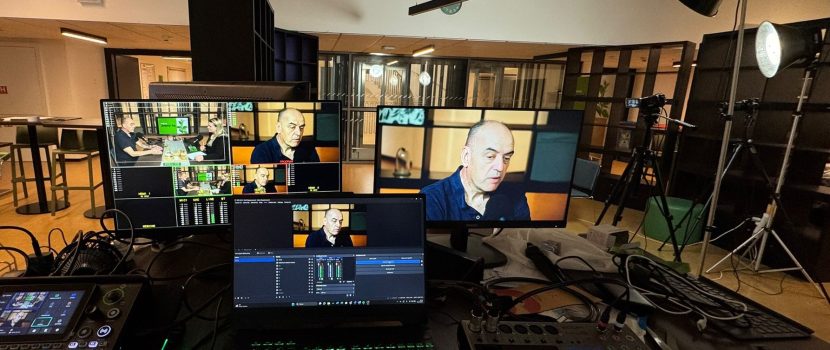
The podcast is recorded directly on the faculty premises amidst the daily hustle and bustle of the university. “We record in areas where students walk by. We didn’t want to create an isolated studio cut off from reality,” Krystyník explains. However, the project also aims to change environments; the studio is mobile, and the creators plan to record in the field, interviewing people who work directly in the landscape.
Special Episodes with a Live Audience
In addition to standard episodes, there will be special editions focused on single themes, offering broader discussions with multiple experts and a live audience. These specials will be moderated by doc. Josef Trögl, a long-time science communicator and EU Climate Pact Ambassador. He is known for explaining complex issues to laypeople with clarity and wit.
First Episode: Drastic Insect Decline and Drying Landscapes
In the first episode, Prof. Jakub Hruška analyzes the issue of the drained landscape, where decades-old canals—often forgotten by the public—still run through forests and fields.
While previous governments spent billions on drainage, today it is a primary cause of the landscape drying out. “Now it’s time to simply pour billions back in to reverse it. This is a task for the state, as no private landowner is capable of doing it robustly enough to make it work across the entire landscape,” Hruška explains. He also highlights the threat posed by the loss of insects:
“Europe has lost about 70% of its insects by weight over the last 30 years. It’s as if Prague suddenly had only 300,000 residents instead of a million. There are no mosquitoes, we can sit outside comfortably—but who cares? Nature cares. It affects pollination and leads to a decline in birds because they have no food for their young. Insects are tied to many delicate webs in nature.”
He also revisits the research report on the Bohemian Switzerland fire, which he led, and which was subsequently inaccurately distilled into the recurring quip: “Dry wood doesn’t burn.”
Room for Long-form Conversation
The podcast intentionally utilizes a longer format. Instead of “soundbites,” it offers conversations that allow for the development of arguments and context. “The environment is not a black-and-white topic. The debate about it should reflect that,” adds Nagel.