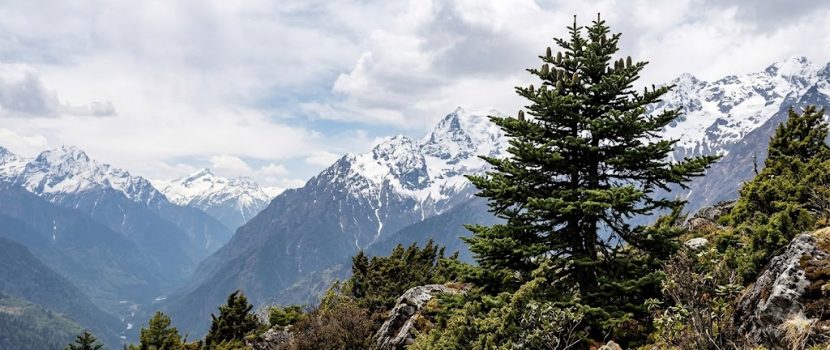
Himalayan fir growth in central Bhutan reflects variability in temperature and precipitation
Mountain ecosystems, especially those at the highest altitudes, are sensitive to current climate change. Proxy archives may provide an insightful tool to better understand ongoing changes and evaluate future scenarios. Trees have traditionally been used as such archives, as they often respond sensitively to environmental change. Thus, we studied tree-ring records of forest-line species Abies densa Griff. growing in the Eastern Himalayas, central Bhutan, to evaluate the effect of climate on the growth of this species. The annual chronologies were generated using standard dendrochronological methods and then compared with climatic data from the CRU TS database. The results demonstrate a negative effect of summer temperatures on the width of the annual rings, suggesting possible stress caused by higher temperatures during the monsoon season. On the other hand, a positive effect of temperatures on tree growth was observed during late winter months. The response to rainfall was mixed, with a positive effect on growth in November and a negative effect in May and January, suggesting a later onset of the vegetation season. To our knowledge, we present the first dendroclimatological study on this long-lived species in central Bhutan, portraying its potential for future climate and environmental research and applications.
Reference: LEHEJČEK, Jiří; VÁVRŮ, Gabriel; WANGCHUK, Sangay; SVOBODA, Miroslav a BOONEN, Katrien. Himalayan fir growth in central Bhutan reflects variability in temperature and precipitation. Online. Journal of Forest Science. 2025, roč. 71, č. 10, s. 516-524. ISSN 1212-4834. Dostupné z: https://doi.org/10.17221/58/2025-jfs.